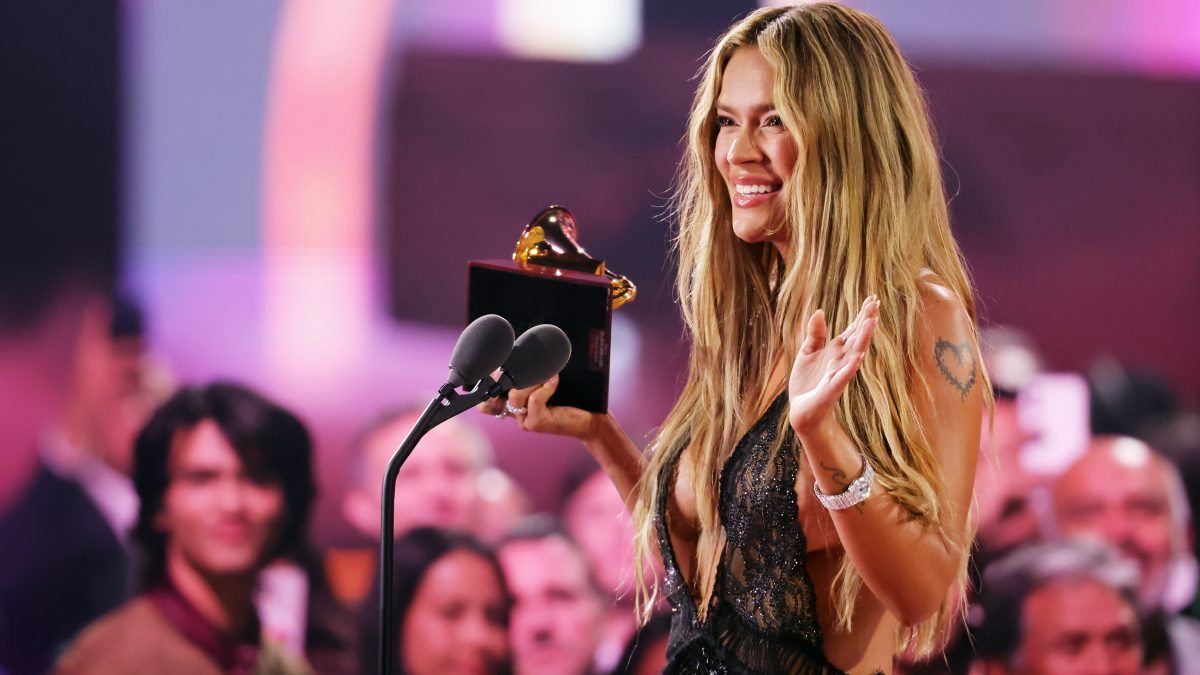
There’s something incredibly powerful about seeing women who look like us, sound like us, and reflect our culture finally recognized on one of music’s biggest stages. The 2027 Grammy nominations recognize quite a few of our favorite Latina music artists, including Karol G, Mon Laferte, Young Miko, Elena Rose, Anitta, Shakira, Eliane Elias, Melissa Aldana, and Lupita Infante, across categories spanning Latin pop, música urbana, música Mexicana, global music, and jazz. And it’s about time.
While these nominations are certainly reason enough to celebrate the individual accomplishments of each of these artists, they also represent something much bigger for our communities. For generations, Latina musicians have helped shape the sound of popular music, often without receiving the same visibility or recognition as their white peers. Seeing so many women of Latin American and Caribbean heritage represented across musical genres is an important reminder that our stories, sounds, and contributions deserve to take up space everywhere—not just in categories specifically designated for Latin music. Period.
There’s an important distinction to acknowledge between seeing Latina artists celebrated in Latin music categories and seeing them recognized in spaces like global music and jazz. While representation in Latin music categories matters, it can also reinforce the idea that we’re an entirely separate musical category. But seeing artists like Eliane Elias and Melissa Aldana recognized in other genres shows that Latina musical excellence isn’t limited to the genres the mainstream industry traditionally associates us with. Latina artists don’t just make music for Latine audiences and communities. Like artists from any background, their work contributes to the global music conversation, whether it’s in Spanish or not. The reality is that Latinas deserve to be celebrated for the music they make and not just for making music the industry categorizes as Latin. The world needs to finally understand that Latin music doesn’t just have one sound y punto.
We’ve seen Shakira put out music that crosses language and cultural boundaries, most recently through her song “Dai Dai” with Burna Boy. Anitta’s nomination demonstrates how she’s helped bring Brazilian pop music to a global audience. Eliane Elias’s nomination for Best Latin Jazz Album highlights Latinas’ contributions to jazz, a genre with a rich Black American and diasporic history. Meanwhile, Melissa Aldana’s nomination in the same category brings attention to the role Latina instrumentalists have played in the jazz world. All of this broadens the image of who gets to be recognized as an artist, beyond her Latina identity.
For years, mainstream conversations about Latina artists focused on their ability to cross over into the English-language market and appeal to non-Latine audiences. In the late 1990s and early 2000s, we had the Latin Explosion, when artists like Shakira, Jennifer Lopez, Ricky Martin, and Enrique Iglesias helped bring Latin pop into mainstream music and popular culture. It was a time when record labels, radio stations, and MTV finally recognized the commercial power of Latin music. The Latin music industry’s growing visibility also led to the establishment of the Latin Recording Academy in 1997 and eventually the inaugural Latin Grammy Awards in 2000.
Then came the global rise of música urbana, which gained momentum through reggaeton and Latin trap and reached new heights with Bad Bunny’s success, particularly following his 2022 album Un Verano Sin Ti. His rise to become one of the world’s biggest music artists, without abandoning Spanish or reshaping his sound to cater to the U.S. mainstream, helped change the relationship that existed between Latin music and the American music industry. While he wasn’t the first artist to achieve major commercial success without switching to English—Daddy Yankee had already helped bring reggaeton to international audiences—Bad Bunny’s success further challenged the industry’s traditional expectations of Latin artists.
That shift also helped create new opportunities for Latina artists working within a genre that had historically been dominated by men. We’ve seen how artists like Karol G have since become global superstars in their own right, while a newer generation, including Young Miko, continues to expand what women in música urbana can sound like, look like, and represent. Their success is part of a larger evolution in which Latina artists are no longer simply trying to find a place in the global music industry; they’re helping shape its sound.
Seeing so many Latinas nominated for Grammy Awards represents so much more than a moment of representation for Latina artists. It reflects how much the musical landscape has changed and how much room Latina women have to define it for themselves. Today, artists like Karol G, Young Miko, and Elena Rose are building on that cultural and commercial momentum. These Grammy nominations reflect that evolution. They recognize how Latina artists have expanded women’s visibility across genres and proven their contributions can no longer be confined to one sound or one category. It’s about time the rest of the world caught up with the magic Latina artists have long brought to the music industry and will continue to contribute.